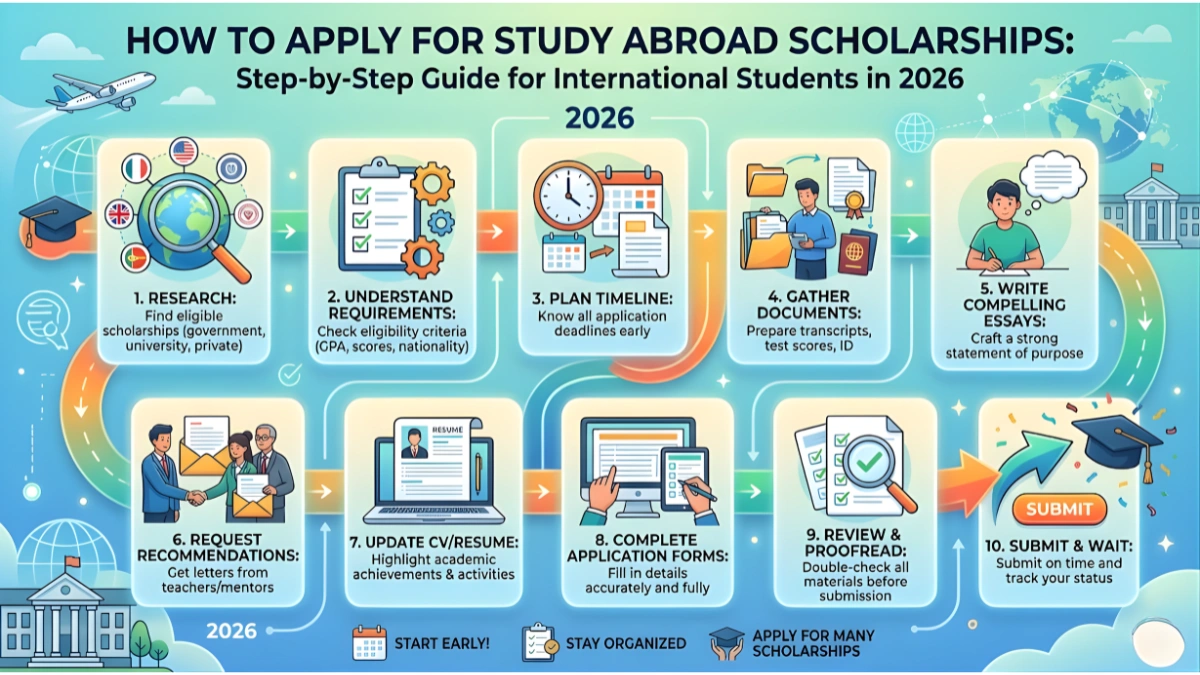
Applying for study abroad scholarships has become one of the most important parts of international education planning because scholarship competition is now extremely high across major countries such as the United States, the United Kingdom, Canada, Germany, and Australia. In 2026, students who receive scholarships usually succeed not only because of academic marks but because they prepare documents early, understand eligibility carefully, and present a clear academic purpose. Many students miss strong opportunities simply because they apply late or submit weak supporting documents. A step-by-step scholarship strategy helps improve both funding chances and university admission outcomes. Scholarships often reward preparation as much as academic excellence.
Step 1: Shortlist Scholarships Based on Country and Degree
The first step is identifying scholarships that match the country, degree level, and subject area being targeted. Students often make the mistake of applying broadly without checking whether the scholarship supports undergraduate, master’s, or doctoral study. Some scholarships are country-specific, while others are linked directly to universities or government programs. A carefully filtered shortlist saves time and improves application quality because every scholarship has different priorities. Students should begin this process months before university deadlines so that scholarship planning and admission planning move together.
Step 2: Prepare Academic Documents in Advance
Academic transcripts, degree certificates, language test scores, passport documents, and financial papers should be prepared early because scholarship deadlines often arrive quickly after admission windows open. Many students lose opportunities because one required document is delayed or incorrectly formatted. Clean document preparation also helps when applying to multiple scholarships because the same academic base can be reused with adjustments. Strong documentation creates the first level of credibility before essays are reviewed.
| Application Step | What to Prepare | Main Purpose |
|---|---|---|
| Step 1 | Shortlist scholarships early | Match eligibility correctly |
| Step 2 | Prepare academic documents | Build strong application base |
| Step 3 | Write statement of purpose | Explain academic goals clearly |
| Step 4 | Collect recommendation letters | Add credibility |
| Step 5 | Submit before deadlines | Avoid rejection risk |
Step 3: Write a Strong Statement of Purpose
A statement of purpose is often the most important part because scholarship committees want to understand why the student chose a specific country, university, and future career direction. Chevening Scholarship and many other major scholarships strongly evaluate leadership potential and long-term impact through written statements. A strong statement should explain academic background, future goals, and why the scholarship matters.
Step 4: Secure Strong Recommendation Letters
Recommendation letters should come from teachers, professors, or employers who know the student’s academic or professional strengths well. Generic recommendation letters usually perform weakly because scholarship committees prefer detailed examples of ability, responsibility, and achievement.
Step 5: Submit Early and Track Every Deadline
Fulbright Program and similar competitive scholarships often reject late or incomplete applications automatically. Submitting early also allows time to correct mistakes if any issue appears.
Why Scholarship Applications Need Long-Term Planning
Students who begin preparation early usually write stronger applications because they have time to improve essays, compare scholarships, and gather stronger documentation.
Conclusion: A successful study abroad scholarship application depends on early planning, strong writing, accurate documentation, and disciplined deadline management.
Disclaimer: Scholarship deadlines, eligibility rules, and required documents may vary each year depending on country and program.